"MY DAD" by DAVID DIAMOND
I close my eyes and see my father dancing in our little house in Levittown. He dances barefoot and alone, joyfully, to the hopeful songs of early Israel.
My father was born in Philadelphia in 1918, in the final months of World War I, and lived his earliest years in the house next to the one in which Edgar Allen Poe wrote the Raven. His parents, Boris and Lena Diamond, were newly arrived immigrants from Ukraine, making their way as a shopkeeper and tailor. As a boy he delivered ice to businesses in North Philadelphia and sold the Daily News outside of Shibe Park. He saw Babe Ruth hit two home runs, watching games from the rooftops outside the ballpark.
At the age of 16, after his parents' divorce, he left school to become a cabinetmaker's apprentice, showing an early talent for intricate woodworking. "It must have been rough for your father," his cousin Billy Gottlieb explained to me a few years ago. "They wanted him to produce things quickly but he was a perfectionist." He lived with his father in a third-floor walkup and in the days before running shoes, would run daily around the reservoir in Fairmount Park.
In October, 1938, shortly after he turned 20, a few of his friends stopped their car and asked my Dad if he wanted to join them - they were driving to South Philadelphia to meet some girls. He was shy and quiet, but reluctantly, he agreed. One of the girls was my mother, who stood on her porch talking to the boys. When they left, she told her friend, "The only one I liked was that Willy Diamond."
He was too shy to ask her out, so he got his friend Izzy Schwartz to call my Mom for their first date, a Halloween party. After that, during each date he would confirm the next one before leaving. In a story that my daughter Kaley loves, whenever he came to visit her, Mom would make him tea but boil the water on a low flame, so that he would stay longer. And it worked. He stayed for 78 years.
In 1941, as World War II approached, they told my grandfather they wanted to get married, but he implored them to wait - the world was too unsettled, he said. They ignored his advice.
My father memorized the eye test so that he could enlist in the Navy, where he built bases in the Philippines and New Guinea. He told my sister Marcy that he never thought he would live to return. She was three months old when he left for the war and not quite three years old when he returned, in the middle of the night. That morning, Marcy reported to my mother that there was a man in her bed, to which she famously replied, "That's no man, that's your father."
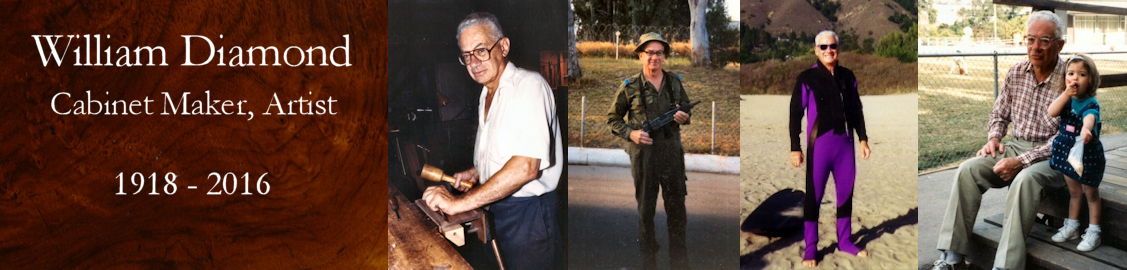
On the day my sister Yona was born in 1948, he suffered a work injury that severed one of his precious fingers. Dad was as determined as he was talented - it never affected his ability to produce the furniture that today graces so many of Philadelphia's churches and the hand-carved reproductions of 18th Century British and American furniture that serve as the centerpieces for so many homes.
He may have been born in 1918 but my Dad's life truly began in the Spring of 1951, when he brought his wife and two young daughters to live in Kibbutz Gesher Haziv in the three-year old state of Israel. The horrors of the Holocaust had made Dad an ardent Zionist and he lovingly embraced his new home - a tin hut on a gentle hill above the Mediterranean Sea in the Western Galilee. He worked in the fields and built furniture for the kibbutz and felt connected to something larger than himself. But six months after arriving, my mother became seriously ill while pregnant with me - she lost 25 pounds in her fifth month - and he took his family home, broken and broke.
In so many ways, he lived the remainder of his life in the shadow of the time he lived in Israel, a place he returned to several times throughout his life - either to visit his children there or for stints volunteering for the Israeli Army.
The numbers tell the story of a beautiful life. My father lived to the age of 97. He was married 75 years. He watched seven grandchildren read from the Torah.
He loved history. He loved Russian literature and he loved classical music, especially Beethoven. He could identify any composer after hearing just a few bars of music. I played a game with him. We would tune into the classical music station. I would ask him to identify the composer. He never missed. Once, he was a bit perplexed but said, "I think it's one of the Italian composers from the 1730's but I don't know which one." A minute later, the announcer said something like, "That was Guisseppi Scalitti, an obscure Italian composer from 1734." That's a true story.
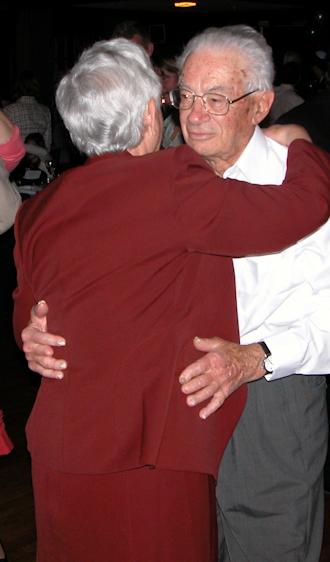
He loved music, but he never liked to dance.
He loved driving back roads to swim in the ocean. He loved diving off the high board - even into his seventies. Into his early nineties he couldn't resist walking across fallen logs he found on his daily hikes in the woods. On a family trip to Yosemite, Kaley, Tia, Mom and I held our collective breaths when he balanced on a log perched above a roaring stream. He made it across. He was youthful. He loved walking in nature.
He loved his daily shot of Old Overholt rye whiskey - and always gave my Mom a kiss after taking it. He loved mahogany and curly maple and walnut. He appreciated fine woodworking. You could watch a movie with my Dad and there would be a scene with a beautiful woman in a bikini and he would say, "Would you take a look at that armoire?"
He loved animals. Dad was an avowed vegetarian for the last 48 years, by my calculation. When they proposed allowing deer hunting in a local park, he was out there protesting.
He loved helping people. "Thank you for making the beautiful bookcase for our synagogue, I admire it every time I walk past." "Thank you for repairing my grandfather's chair. It means the world to me to have it restored." I read through dozens of such thank you notes while cleaning out the secretary desk he made for us in his workshop in our attic. He built the ark for Gill's school.
He and my Mom tended to ill relatives, they came to the aid of immigrant families, they performed the invaluable good deed of bringing a foster child - a 11-year-old orphaned child - into our little house in Levittown and raising her as their own daughter. When I tell people about Hedy's story, I still can't believe the sacrifice and love behind it.
He loved doing good deeds. Above all, he loved my Mom. Frankly, who wouldn't?
So we are taking that long drive back from Yosemite. I'm in the front seat. Dad is riding shotgun. Tia, Kaley and Mom are in the back, sleeping. The music on the CD player is the Weavers' Greatest Hits. And the song that comes on is Tzena Tzena.
"What's the story behind this song?" I ask my Dad, because he always knows.
Oh, it's a song about soldiers in Israel in the 1940s, he says.
It wasn't an idle quiz. The song is important to me. It was the song they played at my wedding, as friends lifted my new bride and me on chairs, bringing us closer to God.
And as I close my eyes, I am five or six years old and coming home after sledding on Appletree Drive. There, on the warm tile floors of our little house, my father is dancing alone and barefoot, joyfully, to the optimistic songs of early Israel.
Now the only songs that could make my father dance are the only songs that can make me cry.